
Obstructive vs. Restrictive Breathing: Two Very Different Lung Stories
When lungs struggle, they usually fail in one of two distinct ways — and telling them apart is the whole game in respiratory diagnosis.
The core divide. Restrictive disease means the lungs simply can’t expand as much as they should causing total lung capacity to drop, whether the cause sits inside the lung tissue itself or comes from something squeezing it from outside. Obstructive disease is the opposite problem: air gets in fine, but struggles to get back out, thanks to narrowed or resistant airways that trap gas behind them.
Spotting obstruction. The telltale sign is a reduced FEV1/FVC ratio, ideally judged against the lower limit of normal rather than a flat 0.70 cutoff. Lung volume testing — TLC, thoracic gas volume, residual volume — reveals the hyperinflation and gas trapping that often comes with it. On a flow-volume loop, the expiratory curve takes on a concave, “scooped” shape. Culprits include asthma, COPD, bronchiectasis, cystic fibrosis, and small-airways disease, sometimes complicated by upper-airway or occupational exposures.
Spotting restriction. Here the flow-volume loop simply shrinks — its shape stays roughly normal, just smaller. Causes split into intrinsic (the lung tissue itself is stiff or diseased, as in pulmonary fibrosis or sarcoidosis) and extrinsic (something outside the lung limits expansion — obesity, chest wall deformity, neuromuscular weakness, or diaphragm dysfunction).
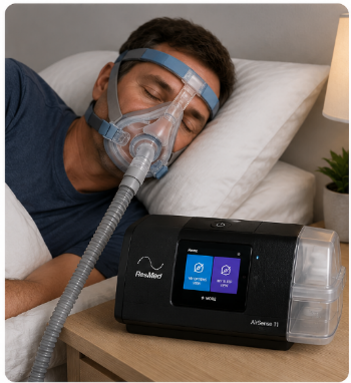
Managing each. Obstructive conditions lean on bronchodilators, inhaled corticosteroids for asthma, smoking cessation, pulmonary rehab, and airway clearance. Restrictive disease management is more about treating the underlying cause, pulmonary rehab, oxygen therapy, and non-invasive ventilation when respiratory failure or neuromuscular disease is in play.
Why the lab matters. Spirometry, lung volumes via plethysmography, DLCO, and respiratory muscle pressures (MIPs/MEPs) together let clinicians characterize severity, catch mixed patterns, and track disease over time — turning a set of numbers into a diagnosis and a management plan.
Bottom line: restrictive lungs can’t fill; obstructive lungs can’t empty. Everything else — the tests, the causes, the treatments — follows from that one distinction.
References
American Thoracic Society, & European Respiratory Society. (2005). Standardisation of the measurement of lung volumes. European Respiratory Journal, 26(3), 511–522. https://doi.org/10.1183/09031936.05.00035005
•Global Initiative for Asthma. (2026). Global strategy for asthma management and prevention: 2026 update. https://ginasthma.org/2026-gina-strategy-report/
•Global Initiative for Chronic Obstructive Lung Disease. (2025). Global strategy for prevention, diagnosis and management of COPD: 2025 report. https://goldcopd.org/2025-gold-report/
•Graham, B. L., Steenbruggen, I., Miller, M. R., Barjaktarevic, I. Z., Cooper, B. G., Hall, G. L., Hallstrand, T. S., Kaminsky, D. A., McCarthy, K., McCormack, M. C., Oropez, C. E., Rosenfeld, M., Stanojevic, S., Swanney, M. P., & Thompson, B. R. (2019). Standardization of spirometry 2019 update: An official American Thoracic Society and European Respiratory Society technical statement. American Journal of Respiratory and Critical Care Medicine, 200(8), e70–e88. https://doi.org/10.1164/rccm.201908-1590ST
•Stanojevic, S., Kaminsky, D. A., Miller, M. R., Thompson, B., Aliverti, A., Barjaktarevic, I. Z., Cooper, B. G., Culver, B., Derom, E., Hall, G. L., Hallstrand, T. S., Leuppi, J. D., MacIntyre, N., McCormack, M., Rosenfeld, M., & Swenson, E. R. (2022). ERS/ATS technical standard on interpretive strategies for routine lung function tests. European Respiratory Journal, 60(1), 2101499. https://doi.org/10.1183/13993003.01499-2021
•Swanney, M. P., O’Dea, C. A., Ingram, E. R., Rodwell, L. T., & Borg, B. M. (2017). Spirometry training courses: Content, delivery and assessment—A position statement from the Australian and New Zealand Society of Respiratory Science. Respirology, 22(7), 1430–1435. https://doi.org/10.1111/resp.13133