
A recent investigation has been conducted to determine the relationship between cardiac functioning and the presence of K-Complexes in sleep. The study followed forty healthy adolescents aged 16–22 y (19 females) and studied heart rate (HR) fluctuations associated with both spontaneous and evoked KCs over two nights. Participants were studied using two randomised overnight polysomnography recordings in sound attenuated, temperature controlled rooms. One night auditory tones of 1000kz were presented binaurally at 80db for 50msc at a random interval throughout the night in aim to elicit KCs in the subjects and a second night was also studied in noise isolation (i.e no auditory tones).
A clear biphasic cardiac response was observed to evoked and spontaneous KCs; with an initial acceleration in HR followed by a deceleration (P < 0.001). HR acceleration occurred immediately to KCs in response to tones presented in the first third of the interbeat interval, but was delayed a beat when the tone occurred later in the cardiac cycle (P < 0.05). Differences between genders were also evident where pretone baseline HR was higher, and the magnitude of the HR response was blunted and delayed, in females compared to male (P < 0.001). Also, pretone baseline HR was lower when a tone elicited a KC compared to when it did not (P < 0.001), suggesting that KCs are possibly more likely to be elicited by external stimuli in states of reduced cardiac activation.
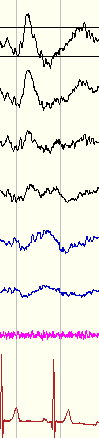 The strict dependency observed between KCs and cardiac control indicates a potential role of KCs in modulating the cardiovascular system during sleep. Sex differences in the KC-cardiac response indicate the sensitivity of this measure in capturing sex differences in cardiac regulatory physiology. As tones that were not accompanied by a KC lacked a cardiac response, strongly suggests that the biphasic cardiac response is closely linked with the K complex itself.
The purpose of this study was to gain insight into the functional significance of K complexes and the autonomic cardiac response. The investigation showed a clear pattern associated with K complexes and a marked acceleration and gradual deceleration of heart rate. It was also found that this pattern occurred much slower in artificially induced K complexes in comparison to “natural” (unstimulated) k complexes. As Despite a relatively small sample size in this study appears to present valid results as it was a replication of previous research which found similar response.
Citation:
Abstract outline taken from Journal Sleep Volume 39, Issue 05
de Zambotti M, Willoughby AR, Franzen PL, Clark DB, Baker FC. K-complexes: interaction between the central and autonomic nervous systems during sleep. SLEEP 2016;39(5):1129–1137.