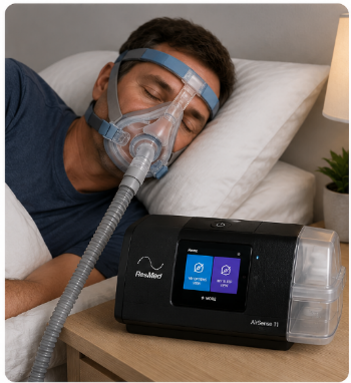

CPAP therapy is the ‘gold standard’ in treating OSA, however the reported positive benefits are variable within individuals, with limited or partial reversibility of cognitive deficits observed. Cognitive testing reveals impairments in vigilance, attention, visuospatial abilities and executive functions and some aspects of memory.
Quantitative electroencephalography EEG measure sleep microarchitecture and provide sensitive markers of cognitive decline in ageing and neurodegeneration and cognitive deficits in patients with OSA. EEG abnormalities are observed in untreated OSA, which include reduced SW frequency and reduced sleep spindle brain activity in NREM sleep, and REM EEG shows greater EEG slowing compared to controls. These EEG oscillations play key roles in sleep-mediated learning and memory processes and these abnormalities underlie cognitive impairment in untreated OSA.
This study assessed 167 patients with OSA (age 50 ± 13, AHI 35.0 ± 26.8) before and after 6 months of CPAP. Cognitive tests assessed working memory, sustained attention, visuospatial scanning, and executive function. All participants underwent overnight polysomnography at baseline and after CPAP. After CPAP, improvement in disease severity metrics and altered sleep architecture resulting in greater sleep efficiency, increased SWS and REM sleep duration, and reduced time spent in stage N2 sleep. Sleep microarchitecture showed increased sleep spindle density in stage N2, reduced EEG slowing in REM along with increased relative delta power and increased duration of REM.
The benefits of 6 months of CPAP therapy were measured by cognitive performance and sleep EEG microarchitecture in NREM and REM sleep. Performance across all cognitive domains were enhanced, along with improved sleepiness and mood; set-shifting related to executive function, working memory and sustained attention all improved in the CPAP therapy groups compared to controls
Citation: Angela L D’Rozario, Camilla M Hoyos, Keith K H Wong, Gunnar Unger, Jong Won Kim, Andrew Vakulin, Chien-Hui Kao, Sharon L Naismith, Delwyn J Bartlett, Ronald R Grunstein, Improvements in cognitive function and quantitative sleep electroencephalogram in obstructive sleep apnea after six months of continuous positive airway pressure treatment, Sleep, Volume 45, Issue 6, June 2022, zsac013, https://doi.org/10.1093/sleep/zsac013