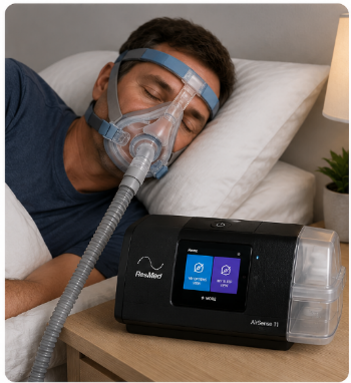

Our peers from (mostly) Melbourne recently published a systematic review looking to assess the use of portable sleep devices to evaluate obstructive sleep apnoea (OSA). MBS funded sleep studies fall into two categories; type 1 (in hospital/laboratory) sleep studies and type 2 (home or ambulatory) sleep studies. Type 1 sleep studies are the gold standard for diagnosing OSA, however there are some limitation with this test, mostly relating to access and cost.
Ambulatory monitoring, or home sleep studies are used fairly regularly in Australia. This test is generally considered useful to rule in or rule out OSA. Khor et al looked into the research to confirm the efficacy of these devices in diagnosing or ruling out OSA. They did include less comprehensive devices (type 3 & 4 devices) also. They hoped to better inform clinical practice and research, by evaluated diagnostic performances, study cost and patients’ experience of different levels of portable sleep studies (type 2, 3, and 4), as well as wearable devices and non-contact systems, in adults.
They found that “despite varying study designs and devices used, portable diagnostic tests are found to be sufficient for initial screening of patients at risk of OSA.” However, they also noted that “Future studies are needed to evaluate cost effectiveness with the incorporation of portable diagnostic tests into the diagnostic pathway for OSA, as well as their application in patients with chronic respiratory diseases and other comorbidities that may affect test performance.”
Citation:
Yet H. Khor, Su-Wei Khung, Warren R. Ruehland, Yuxin Jiao, Jeremy Lew, Maitri Munsif, Yvonne Ng, Anna Ridgers, Max Schulte, Daniel Seow, William Soon, Thomas Churchward, Mark E. Howard. Portable evaluation of obstructive sleep apnea in adults: A systematic review. Sleep Medicine Reviews. Volume 68, 2023. 101743. ISSN 1087-0792. https://doi.org/10.1016/j.smrv.2022.101743.
The article can be found here: https://www.sciencedirect.com/science/article/abs/pii/S1087079222001563