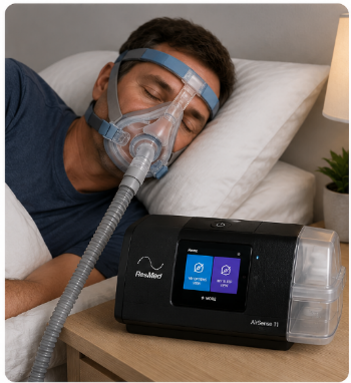

Consumer sleep trackers can support engagement with sleep health and highlight patterns across nights. However, their outputs may also create concern when the reported data do not align with perceived sleep quality or daytime functioning.
What can wearable data tell us?
- Most devices estimate sleep from movement, heart rate and related physiological signals. These signals are processed through device-specific sensors, firmware and proprietary algorithms before appearing as sleep measures in the app.
- Device wear, signal quality and individual characteristics such as age, body composition, mobility, and health status can influence the resulting estimates.
- Sleep timing and total sleep time are typically the most useful outputs when viewed across several nights.
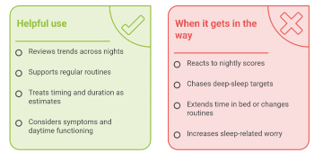
When tracking becomes counterproductive
The term orthosomnia was introduced in a case series of three patients who were preoccupied with obtaining “correct” or “perfect” sleep according tot heir tracker. These patients:
- Trusted the device more than their own sleep experience.
- Focused on achieving a particular sleep duration or amount of deep sleep.
- Changed their routines or spent longer in bed, increasing worry and effort around sleep.
These observations do not establish that tracking causes insomnia. Rather, they demonstrate how wearable data may reinforce unhelpful beliefs and behaviours in susceptible individuals.
Practical takeaway
Interpret wearable data alongside how you feel, your usual sleep patterns and daytime functioning, with more emphasis on trends than individual scores or sleep-stage estimates. If tracking is increasing worry or changing your sleep behaviour, it may be helpful to reduce or pause monitoring and seek advice if sleep problems persist.
References
Baron, K. G., Abbott, S., Jao, N., Manalo, N., & Mullen, R. (2017). Orthosomnia: Are some patients taking the quantified self too far? Journal of Clinical Sleep Medicine, 13(2), 351–354.
Chee, M. W. L., Baumert, M., Scott, H., Cellini, N., Goldstein, C., Baron, K., Imtiaz, S. A., Penzel, T., & Kushida, C. A. (2025). World Sleep Society recommendations for the use of wearable consumer health trackers that monitor sleep. Sleep Medicine, 131, 106506.