
The occurrence of central apnoea’s when applying positive pressure (CPAP) to patients with obstructive sleep apnoea syndrome (OSAS) is called complex sleep apnoea (CompSA). This causes poor adherence to CPAP and persistence of symptoms. In Bogota, a city located at an altitude of 2640 m above sea level, chronic hypoxemia can generate certain instability of the respiratory system during sleep which could increase the presence of central apnoea. It is known that at significant altitudes can increase the presence of central apnoea and periodic breathing[1], and it has been proposed to be a risk factor for central apnoea with positive pressure[2].
The article’s aim was establish the prevalence of central apnoea (central apnoea index >5/h) in adults with moderate or severe OSAS during CPAP titration, and the factors associated with this. Method: Patients over 18 years old with OSAS were referred to the Fundacion Neumologica Colombiana Sleep Center, from January 2008 to June 2010. Polysomnogram (PSG) for CPAP titration was performed according to the American Academy of Sleep Medicine criteria. The prevalence was calculated and the clinical and baseline PSG factors associated with the CompSA were analyzed.
Results: They included 988 patients, 58% men. CompSA prevalence was 11.6%. Factors associated with CompSA were: central apnoea’s in the baseline PSG (OR: 5.34 [3.49–8.16]), history of heart failure (OR: 2.53 [1.58– 4.07]), and male sex (OR: 1.68 [1.06–2.69]).
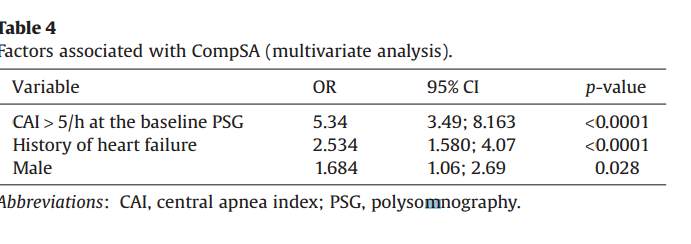
Conclusion: At an altitude of 2640 m, the complex sleep apnoea prevalence was 11.6% and the factors related to this were: CAI at baseline PSG >5/h, a history of heart failure, and being male. Although the prevalence was not as high as expected, given the high altitude, it is important to recognize and follow-up this disorder. These findings may be relevant not only in Bogota but also in populations living at similar altitudes. Further long-term studies are needed to establish the impact of CompSA on treatment adherence and outcomes.
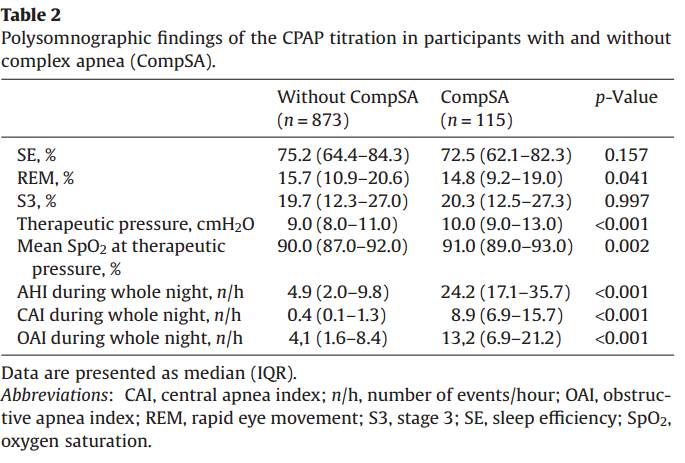
The present study found a greater severity of sleep apnoea at baseline PSG in participants with complex sleep apnoea. Also, in the titration PSG, the AHI in the whole night was higher in the group of CompSA. This could be explained because these people probably resolve their obstructive events later in the titration night than those without CompSA. In fact, the average pressure (cmH2O) required to abolish obstructive events was higher in those with CompSA. Although statistically significant, the difference of 1 cmH2O is probably of little clinical relevance, and it would exclude the “overpressure” as cause of central apnoea’s. The principal strengths of this work are: that this is the first study of prevalence and risk factors of CompSA in a large population adapted to a high altitude, and that the diagnostic and the titration PSG were conducted on different nights.
[1]- Bazurto-Zapata, M. Angelica; Martinez-Guzman William; Vargas-Ramirez Leslie; Herrera Karen; Gonzalez-Garcia, Mauricio. Prevalence of central sleep apnea during continous positive airway pressure (CPAP) titration in subjects with obstructive sleep apnea syndrome at an altitude of 2640 m. Sleep Medicine. Volume 16, Issue 3, March 2015, Pages 343–346. Available on: http://www.sciencedirect.com/science/article/pii/S1389945715000040 .
[2]- Kinsman T, et al. Respiratory events and periodic breathing in cyclists sleeping at 2,650-m simulated altitude. J Appl Physiol 2002; 92:2114– 18. .
[3]- Pagel JF, et al. The effects of altitude associated central apnea on the diagnosis and treatment of obstructive sleep apnea: comparative data from three different altitude locations in the Mountain West. J Clin Sleep Med 2011;7(6):610–15.