

The prevalence of obstructive sleep apnoea (OSA) creates cognitive deficits impacting work efficiency and productivity, and associated cardiovascular and increased metabolic health morbidity. Recently studies have investigated the potential association between OSA and cancer (particularly the solid tumour type) and if these patients are at a higher risk compared to non-OSA patients, by linking the intermittent hypoxia and fragmented sleep to cancer-related biological processes. This study hypothesised that there may be an increased risk for certain types of cancer, such as solid tumours, and susceptibility to OSA.
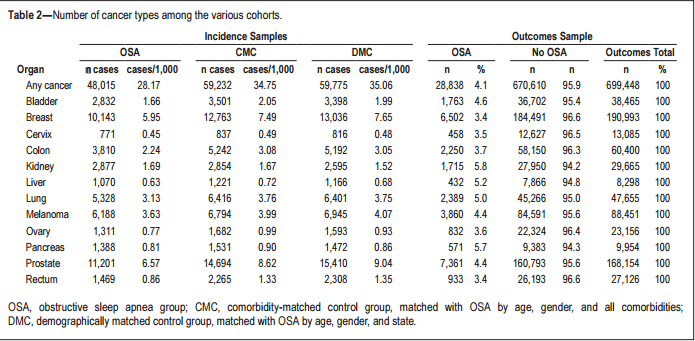
There were three analytic samples of patients; OSA with a demographically matched cohort (DMC), OSA with comorbidity matched cohort (CMC) and patients with cancer and OSA. Data was extracted from the MarketScan Commercial Claims and Encounters database from 2003 to 2012 assessing the incidence of 12 types of cancer in the cohort. There were approximately 5.6 million individuals included within the three samples with a diagnosis of cancer and the presence of OSA. In table 2 the study examined the risk of cancer metastasis and death in patients, where they found the increased risk of solid tumour type cancers such as pancreatic, kidney and melanoma were higher in patients with OSA. There was a reduced risk of breast, colorectal and prostate cancers in patients with OSA.
Significance
From this extensive search of the health insurance database the risk of pancreatic and kidney cancer, as well as melanoma, was found to be higher in apnoeic patients. They did associate reduced risk in cancers such as breast, colorectal and prostate, in patients with sleep apnoea. Therefore the association between sleep apnoea and cancer may be selective, and affect certain types of solid malignancies. However, linking risk of cancer to sleep apnoea requires future studies.
David Gozal, MD, MBA; Sandra A. Ham, MS, MA; Babak Mokhlesi, MD, MSc.