

26 Mar When dreams turn dangerous: The hidden link between REM Behaviour Disorder and Parkinson’s Disease
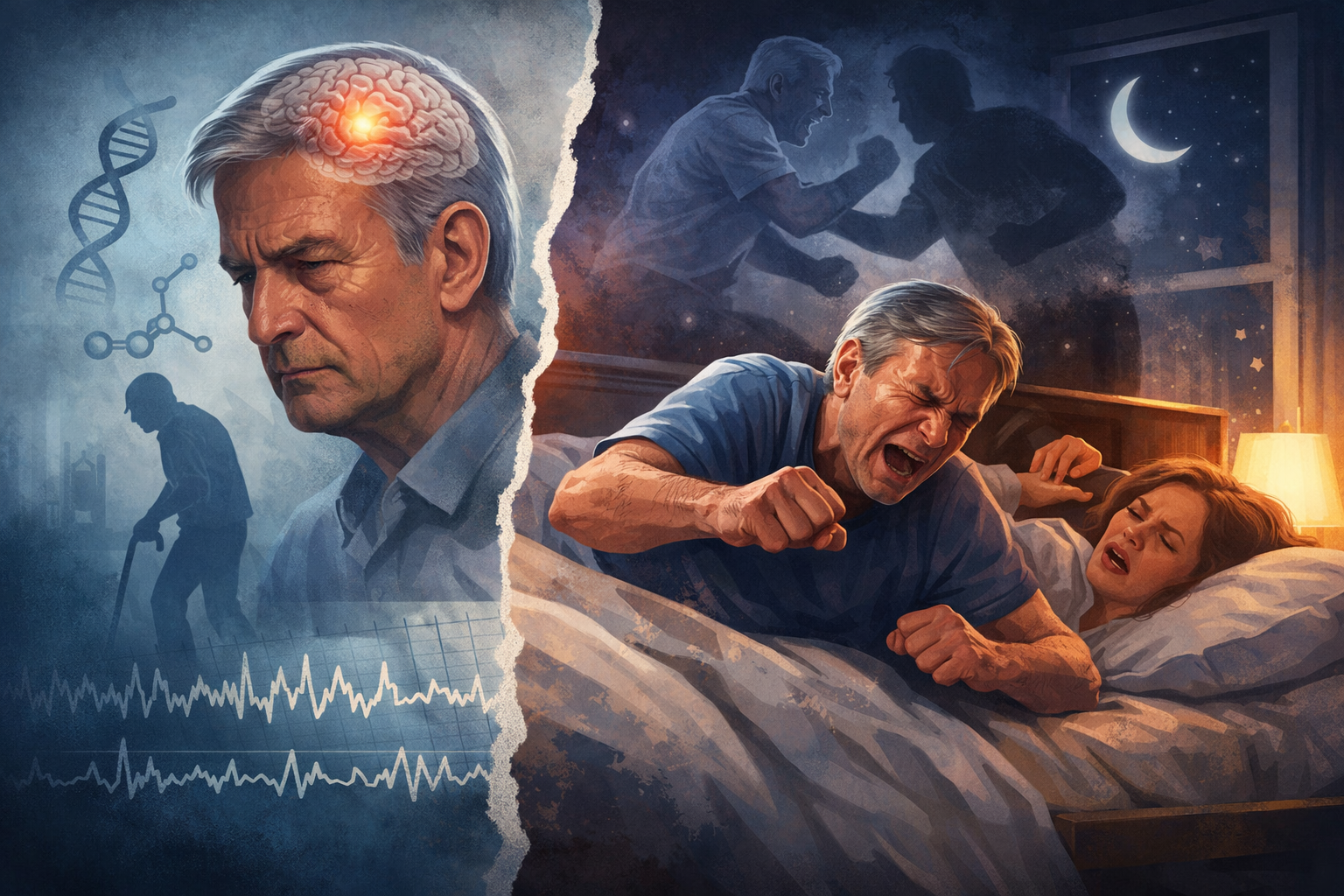
REM Behaviour Disorder (RBD) is a sleep disorder characterised by acting out dreams, often involving, kicking, shouting or fighting while still asleep. RBD is more than just an unusual sleep behaviour; it is an early warning sign of neurological disease, in particular Parkinson’s disease.
REM (Rapid Eye Movement) sleep is a stage of sleep most associated with dreaming. During this sleep stage the body is “paralysed” preventing movement. However, for people with RBD, this protective paralysis is lost and as a result they are able to physically act out their dreams. These dreams are often vivid and intense, relating to violent or frightening content. Due to the nature of the dream content, the individual may strike out, shout or even try to jump out of bed; this poses a safety risk not only to themselves but also to their bed partner.
What makes RBD especially significant is its strong connection to Parkinson’s disease. RBD often appears years or even decades before the typical movement symptoms of Parkinson’s disease develop. This means RBD can act as an early warning sign, allowing early detection and intervention before Parkinson’s disease appears or progresses. RBD is also associated with cognitive impairment, altered blood pressure and heart rate, and increased daytime sleepiness.
Diagnosis often involves an overnight sleep study (polysomnography) to correctly identify RBD, as other sleep conditions such as non-REM (NREM) parasomnias can mimic symptoms. NREM parasomnias present similarly; however, they occur due to brief incomplete awakenings of the brain outside of REM sleep. This brief awakening causes confusion and less coordinated/purposeful behaviour (e.g., sitting up and looking around or sleepwalking).
Treatment for RBD focuses on improving safety and treating symptoms. Treatments include modifying the sleep environment to be safer and medications such as melatonin and clonazepam, which can prevent acting out dreams.
Recognising RBD isn’t just about better sleep; it could be the key to identifying and managing serious neurological disease much earlier. If you move around or talk in your sleep, speak to your GP and explore the option of completing a sleep study.
Sources:
Diaconu, Ș., Falup‑Pecurariu, O., Țînț, D., & Falup‑Pecurariu, C. (2021). REM sleep behaviour disorder in Parkinson’s disease (Review). Experimental and Therapeutic Medicine, 22(2), 812. https://doi.org/10.3892/etm.2021.10244
Mainieri, G., Loddo, G., Provini, F., Nobili, L., Manconi, M., & Castelnovo, A. (2023). Diagnosis and management of NREM sleep parasomnias in children and adults. Diagnostics, 13(7), 1261. https://doi.org/10.3390/diagnostics13071261
Patel AK, Reddy V, Shumway KR, et al. Physiology, Sleep Stages. [Updated 2024 Jan 26]. In: StatPearls [Internet]. Treasure Island (FL): StatPearls Publishing; 2026 Jan-. Available from: https://www.ncbi.nlm.nih.gov/books/NBK526132/
Toba, A., Ishikawa, J., & Harada, K. (2022). Increased blood pressure variability is associated with probable rapid eye movement sleep behaviour disorder in elderly hypertensive patients. Blood Pressure, 31(1), 40–46. https://doi.org/10.1080/08037051.2022.2055531