

15 May Severe COVID and Flu May Raise Lung Cancer Risk Years Later, But Vaccines Can Help
Groundbreaking new research reveals that serious respiratory infections can leave lasting changes in the lungs long after recovery.
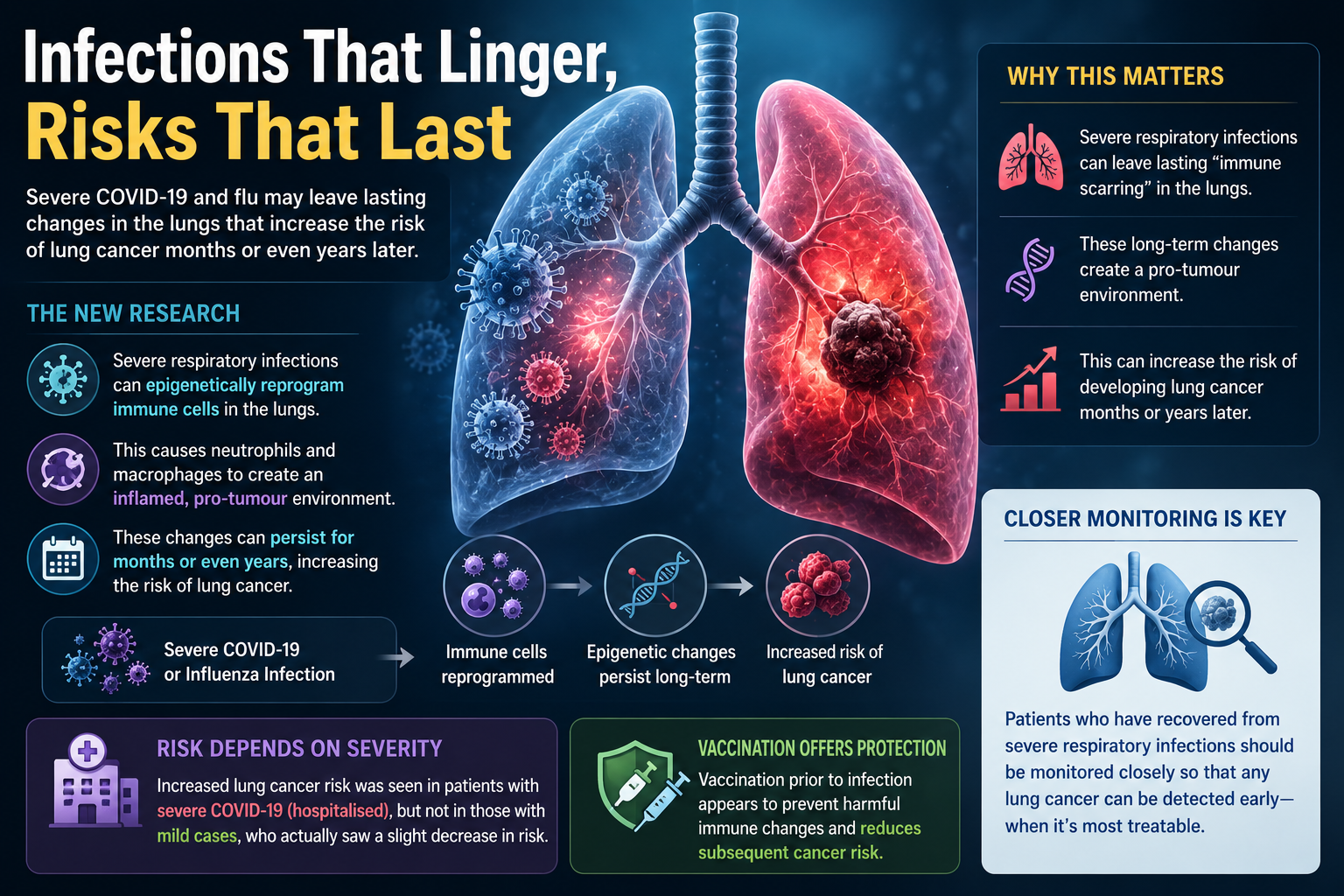
Most people expect to fully recover after a bout of COVID-19 or influenza. But a major new study published in Cell suggests that severe cases of these infections may carry consequences that linger far longer than anyone realised, potentially increasing the risk of developing lung cancer months or even years down the track.
Researchers led by scientist Jie Sun at the University of Virginia discovered that severe respiratory infections can alter immune cells in the lungs in ways that support tumour growth months or even years later, with the increased risk seen mainly after severe infections that required hospitalisation (ScienceDaily, 2026).
Severe COVID-19 and influenza infections can epigenetically reprogram lung and immune cells, creating a pro-tumour environment that increases lung cancer risk (Technology Networks, 2026). Specifically, serious viral lung infections had dramatic effects on immune cells called neutrophils and macrophages that are supposed to protect the lungs, causing them to instead create an inflamed environment where cancer can thrive (ASCO Post, 2026).
Importantly, the increased cancer risk was seen in patients with severe COVID-19, but not in those who had suffered mild cases, who actually saw a slight decrease in risk (UVA Health, 2026).
There is, however, good news. Vaccination prior to infection appears to prevent these harmful immune changes, reducing subsequent cancer risk (Medical Xpress, 2026). As researcher Sun noted, vaccines may do more than prevent hospitalisation, they may also reduce the long-term immune scarring that could raise cancer risk.
The findings are prompting calls for closer monitoring of patients who have recovered from severe respiratory infections, so that any lung cancer can be detected at its earliest and most treatable stage.
References
ASCO Post (2026) Can viral respiratory infections increase lung cancer risk? Available at: https://ascopost.com/news/march-2026/can-viral-respiratory-infections-increase-lung-cancer-risk/ (Accessed: 27 April 2026).
Medical Xpress (2026) Severe COVID-19 and flu can facilitate lung cancer months or years later. Available at: https://medicalxpress.com/news/2026-03-severe-covid-flu-lung-cancer.html (Accessed: 27 April 2026).
Qian, W., Wei, X., Barros, A.J., Ye, X., Zhang, H., Yu, Q., Young, S.P., Yeatts, E.V., Park, Y., Li, C. and Sun, J. (2026) ‘Respiratory viral infections prime accelerated lung cancer growth’, Cell, 189(5). doi: 10.1016/j.cell.2026.02.013.
ScienceDaily (2026) Severe COVID and flu may raise lung cancer risk years later. Available at: https://www.sciencedaily.com/releases/2026/03/260313055130.htm (Accessed: 27 April 2026).
Technology Networks (2026) How COVID and flu infections prime the lungs for cancer. Available at: https://www.technologynetworks.com/cancer-research/news/how-covid-and-flu-infections-prime-the-lungs-for-cancer-410881 (Accessed: 27 April 2026).
UVA Health (2026) Severe COVID-19, flu facilitate lung cancer months or years later. Available at: https://www.uvahealth.com/news/covid-lung-cancer (Accessed: 27 April 2026).