

22 Feb AI is here II: Can Your Sleep Predict Future Health
For thousands of years, humans have tried to outmaneuver biology. In just over a century, life expectancy rose from roughly 30 years in the 1800s to around 80–85 today. Yet despite extraordinary medical and technological advances, that curve has flattened at 85 years. Are we reaching a biological ceiling — or are we simply looking in the wrong place for earlier warning signs?
Unlike the Greenland shark (which can live 400–500 years) or the giant tortoise (200+ years), humans are not evolutionarily designed for extreme longevity. But many of the diseases that limit our lifespan — cardiovascular disease, neurodegeneration, cancer — do not appear suddenly. They evolve silently over years or decades.
The broad medical field currently focusses on symptomatic treatment rather than a cure of underlying disorder, a case more than prevalent in fields like psychiatric and geriatric fields. This is no fault of theirs, rather a systematic hole that has neglected disease for too long without lifestyle intervention. Preventative medicine – usually relying on demographic features and non-invasive bodily data-points – rather identifies disease risk long before symptoms emerge.
Sleep: A Window into Systematic Health
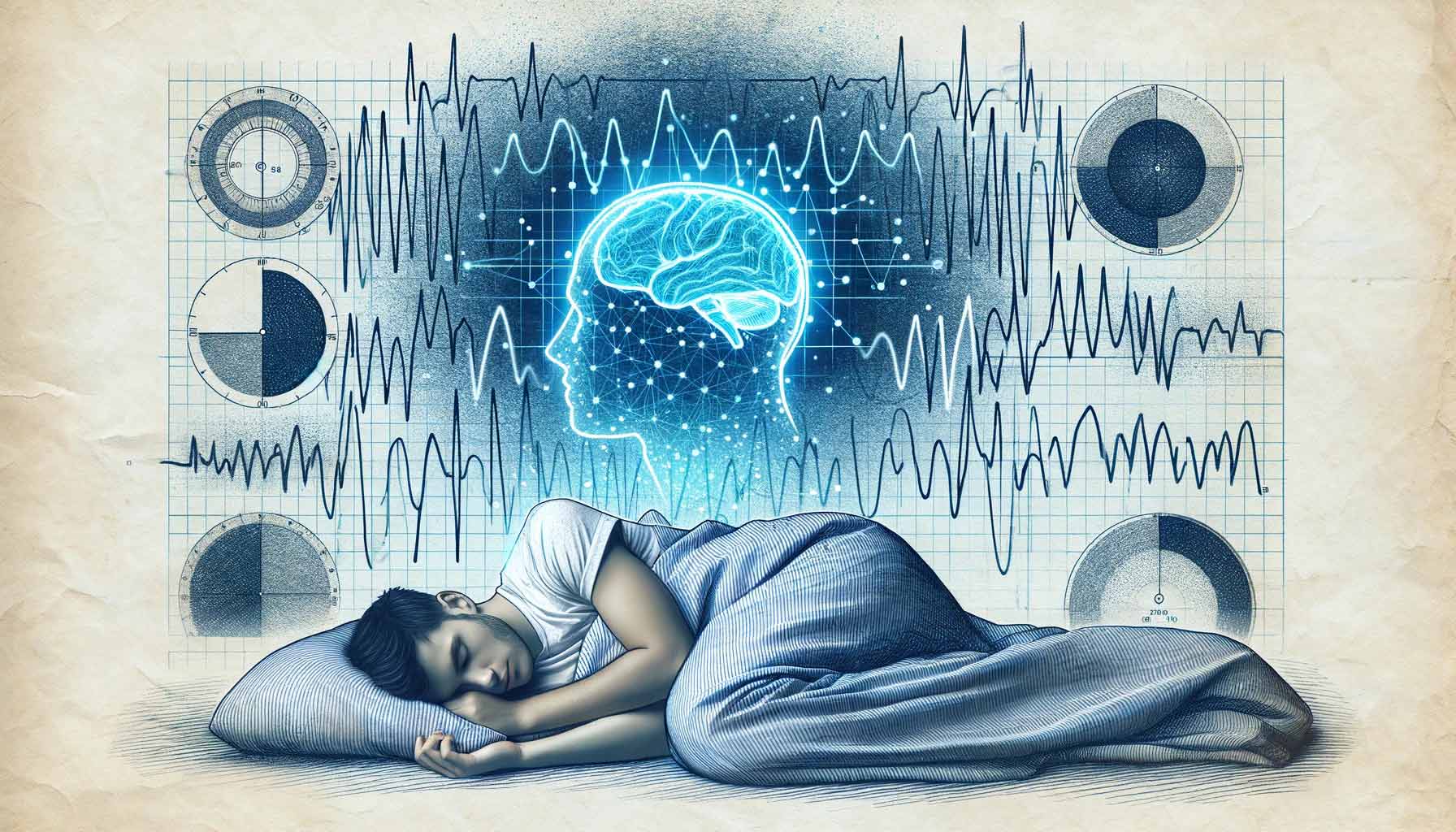
Sleep medicine may offer one of the richest untapped datasets in clinical practice. A single overnight polysomnography (PSG) study records a vast amount of physiological data:
-
Brain wave rhythms (EEG)
-
Eye movements (EOG)
-
Muscle tone (EMG)
-
Respiratory effort and airflow
-
Heart rhythm
-
Oxygen saturation
Traditionally, this data is distilled into sleep stages, apnea indices, arousal frequency, and movement disorders to diagnose conditions such as obstructive sleep apnea, restless legs syndrome, and insomnia, but sleep disturbances often precede countless known psychiatric, cardiovascular, metabolic, and neurodegenerative diseases. The question is obvious:
If we are collecting thousands of pages of physiological information per night, are we extracting its full predictive value?
Emergence of SleepFM for Sleep Study Analysis
Researchers at Stanford University developed SleepFM, an AI model trained on nearly 600,000 hours of sleep data from approximately 65,000 individuals, and a study was published in Nature Medicine under lead author Rahul Thapa. The model was first trained to perform automated sleep staging and detect sleep-disordered breathing, achieving performance comparable to expert scorers (Accuracy: Sleep staging = 81%, Sleep disordered breathing = 87%). It was then trained to predict long-term health outcomes by linking sleep data to longitudinal medical records. Out of more than 1,000 disease categories examined, approximately 130 showed meaningful predictive signal from sleep physiology alone. Prediction performance exceeded 80% for several major disease categories, including:
- Alzheimer’s disease (~91%)
-
Parkinson’s disease (~89%)
-
Hypertensive heart disease (~84%)
-
Myocardial infarction (~81%)
-
Prostate cancer (~89%)
-
Breast cancer (~87%)
-
Six-year mortality (~84%)
The predictive program works by finding biological signals that were not in sync with each other, with co-author Mignot explaining, “The most information we got for predicting disease was by contrasting the different channels… Body constituents that were out of sync – a brain that looks asleep but a heart that looks awake, for example – seemed to spell trouble.”
This systems-level pattern recognition may explain why SleepFM’s Alzheimer’s prediction (91% accuracy) exceeded current gold standard for long-term Alzheimer’s detection via neuroimaging (82-86% accurate within 9 years). Subtle reductions in slow-wave brain activity, spindle density, and REM stability — known correlates of early neurodegeneration — may be embedded in PSG data years before cognitive symptoms emerge.
The model has been extensively validated on diverse demographics and published for open-access use for all sleep clinics across the world in hopes of improving clinical outcomes.
What Next
Sleep is not an isolated neurological event. It is a coordinated, whole-body state requiring tight coupling between brain, autonomic, respiratory, and cardiovascular systems. Disease often begins with subtle loss of synchrony across these systems, and too often does the vast majority of sleep study data go underused in clinical pathways. SleepFM appears capable of detecting these deviations long before clinical thresholds are crossed. The creators of SleepFM have now released the software for open-access to worldwide sleep clinics following extensive validation on diverse demographics. With its use, sleep studies could shift from purely diagnostic tools to predictive instruments — identifying vulnerability rather than waiting for pathology.
References
Thapa, R., Kjaer, M.R., He, B. et al. A multimodal sleep foundation model for disease prediction. Nat Med 32, 752–762 (2026). https://doi.org/10.1038/s41591-025-04133-4
Li, H. et al. A deep learning model for early prediction of Alzheimer’s disease dementia based on hippocampal magnetic resonance imaging data. Alzheimers Dementia 15, (2019) 1059–1070.
*Accuracy is measured via C-Index (measure of true concordance) and AUROC (area under the receiver operating characteristic curve measuring true risk within a time frame)