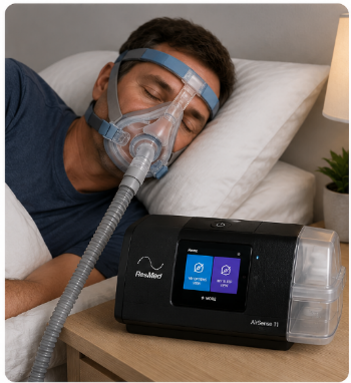

CPAP therapy stands as a beacon of hope for those grappling with obstructive sleep apnoea, yet despite its proven efficacy in restoring memory, reducing sleepiness, and enhancing daily functioning, CPAP compliance remains a significant challenge.
Research has highlighted the transformative effects of consistent CPAP usage. Using CPAP for more than six hours nightly not only restores memory to normal levels but also decreases daytime sleepiness and improves daily functioning. Additionally, CPAP therapy has been shown to elevate mood and decrease blood pressure, offering a comprehensive approach to combating the multifaceted impacts of OSA[1].
However, the stark reality is that a substantial portion of individuals requiring CPAP fail to comply with treatment recommendations, with non-adherence rates ranging from 29% to 83%[2].
Non-adherence to CPAP causes patients to miss out on benefits and suffer consequences to their health. Skipping even a single night of CPAP can cause the reemergence of daytime sleepiness and neurobehavioural deficits, and remarkably, research suggests that even an hour per night of CPAP usage can significantly improve five-year mortality rates[3].
Understanding the usage required to achieve optimal benefits is equally crucial. Studies indicate varying thresholds for different aspects of sleep health: subjective sleepiness (four hours or more), objective sleepiness (six hours), memory (six hours or more), and daily functioning (seven and a half hours or more)[3]. Notably, using CPAP for six or more hours per night increases the likelihood of obtaining normal scores on visual memory tasks by more than eightfold—a testament to the remarkable efficacy of consistent usage[3].
References:
- Gay P, Weaver T, Loube D, Iber C. Evaluation of positive airway pressure treatment for sleep related breathing disorders in adults. Sleep 2006;29:381–401
- Rapelli G, Pietrabissa G, Angeli L, Manzoni GM, Tovaglieri I, Perger E, Garbarino S, Fanari P, Lombardi C, Castelnuovo G. Study protocol of a randomized controlled trial of motivational interviewing-based intervention to improve adherence to continuous positive airway pressure in patients with obstructive sleep apnea syndrome: The MotivAir study. Front. in Psych. 2022: 13. doi=10.3389/fpsyg.2022.947296
- Weaver TE, Grunstein RR. Adherence to continuous positive airway pressure therapy: the challenge to effective treatment. Proc Am Thorac Soc. 2008;5(2):173-178. doi:10.1513/pats.200708-119MG